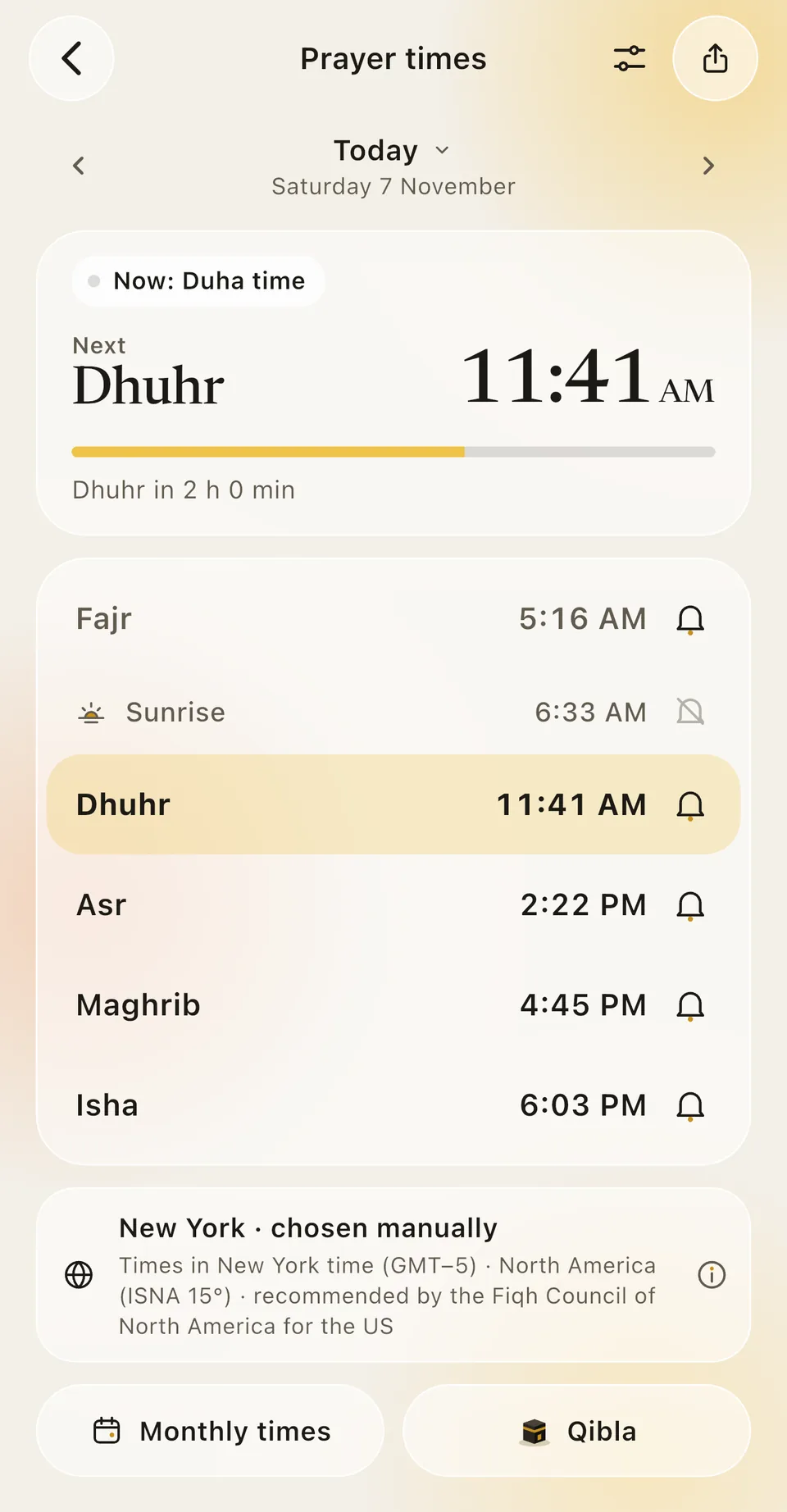
What does a prayer timetable calculate?
It calculates where the sun is in the sky for one place on one date. Sunrise, solar noon and sunset follow from that position alone; Dhuhr is tied to solar noon and Maghrib to sunset. Fajr, Isha and Asr each need a rule.
Steady Deen does this calculation on your phone; see prayer times in Steady Deen.
What is a prayer time calculation method?
A method is a convention for Fajr and Isha: it sets how many degrees below the horizon the sun must be for each. A larger angle means a darker sky, so Fajr comes earlier and Isha later. Some methods give Isha a fixed interval after Maghrib instead of an angle.
Which Fajr and Isha settings do the methods use?
As of November 2026 (version 1.1), Steady Deen offers 22 calculation methods and a “Custom angles” option. The table lists all 22 under the names the app shows, with the Fajr and Isha settings shown on each method’s row on the “Calculation method” page.
| Method | Fajr | Isha |
|---|---|---|
| Moonsighting Committee | Seasonal | Seasonal |
| Muslim World League (18°/17°) | 18° | 17° |
| North America (ISNA 15°) | 15° | 15° |
| Canada – FCNA 13° | 13° | 13° |
| France (UOIF) | 12° | 12° |
| Portugal | 18° | 77 min after Maghrib |
| Russia | 16° | 15° |
| Umm al-Qura | 18.5° | 90 min after Maghrib |
| Egyptian General Authority of Survey | 19.5° | 17.5° |
| Dubai | 18.2° | 18.2° |
| Qatar | 18° | 90 min after Maghrib |
| Kuwait | 18° | 17.5° |
| Gulf Region | 19.5° | 90 min after Maghrib |
| Jordan | 18° | 18° |
| Morocco | 19° | 17° |
| Algeria | 18° | 17° |
| Tunisia | 18° | 18° |
| 18° Fajr & Isha (Karachi) | 18° | 18° |
| Singapore | 20° | 18° |
| Tehran | 17.7° | 14° |
| Indonesia (KEMENAG) | 20° | 18° |
| Turkey (Diyanet approximation) | 18° | 17° |
“Custom angles” lets you set both angles yourself, from 10° to 22° in half-degree steps.
Why are there two Asr times?
Because there are two rules for the shadow length that starts Asr. Steady Deen calls them “Standard” (Shafi’i, Maliki, Hanbali) and “Later” (Hanafi). Standard starts Asr when an object’s shadow has grown by the object’s own height since midday, and Later when it has grown by twice that height, so the Later (Hanafi) time falls later in the day.
Outside Türkiye, you choose. With a location in Türkiye, version 1.1 has no Asr choice, and the method the app chooses there, “Turkey (Diyanet approximation)”, always uses Standard Asr; see which Asr time Steady Deen uses.
How does Steady Deen calculate prayer times in Türkiye?
In Türkiye, Steady Deen calculates on your phone with an approximation of Diyanet’s method, within about ±2 minutes of Diyanet’s times. It is not Diyanet’s own timetable.
With a location in Türkiye, the Fajr row is labeled “Imsak” instead.
Why can your mosque’s timetable differ by a few minutes?
Because a timetable is a method plus several smaller choices, and any of them can differ.
- The method. Different angles move Fajr and Isha.
- The Asr rule. A large gap in Asr alone can mean one side uses Standard and the other Later.
- Added minutes. Some methods shift certain times by fixed minutes, and a printed timetable may add its own.
- Rounding. Timetables round to the minute in different ways. One that always rounds up can read a minute later than one that rounds to the nearest minute.
- The place. A timetable is calculated for one point, and each degree of longitude shifts every time by about four minutes. Steady Deen uses your position, rounded to about 1 km, or one point in the city you choose.
- Height and horizon. Calculated times normally assume a level horizon, and Steady Deen has no setting for height. The hills around you, or how high up you are, can shift the sunrise and sunset you see.
What happens where summer nights don’t get fully dark?
Fajr and Isha are estimated, because on some summer nights far from the equator the sun never sinks to the angle a method asks for. Timetables use different estimates.
Steady Deen uses a high-latitude rule and marks the two times “Estimated”, with “≈” beside the time. Far enough from the equator, with most methods that use two angles, the “Calculation method” page shows a “High latitude rule” setting: “Twilight angle (default)”, “Seventh of the night” or “Middle of the night”.
How does Steady Deen choose a method, and how do you change it?
The app picks one from your country and, in the United Kingdom, your latitude: North America (ISNA 15°) in the United States and Canada, for example, and Turkey (Diyanet approximation) in Türkiye. The table of defaults by country is under which calculation methods you can choose. To change the method:
- Open the Prayer times screen and tap the settings button at the top.
- Under “Calculation”, tap “Method”.
- Tap the method your mosque uses. Each row shows the method’s Fajr and Isha settings, today’s Fajr and Isha times, and how many minutes they differ from your current method.
If you don’t know your mosque’s method, go back to the prayer times settings and open “Match my mosque” under “Calculation”. Choose your mosque’s Fajr and Isha times for today; the app compares them with 11 of the 22 methods and suggests the closest. “Minute adjustments”, in the same section, moves each time by up to 30 minutes.
The next prayer time also appears in the widgets; see how to add prayer times to your Lock Screen.
What can a calculated timetable not tell you?
It cannot tell you which method or Asr time to follow. Steady Deen does not issue religious rulings; that is a question for your local mosque or a qualified scholar you trust.
It is also not your mosque’s timetable. As of November 2026 (version 1.1), the app has no mosque timetables and no iqamah times.
The times are estimates, not an official timetable, and they may differ from your local mosque by a few minutes. When in doubt, follow your local masjid. The calculation library is named under prayer time methods and sources. If a time looks wrong for your location, tell us through Support.